Nitrogen+Syngas 372 Jul-Aug 2021

Market Outlook


Market Outlook

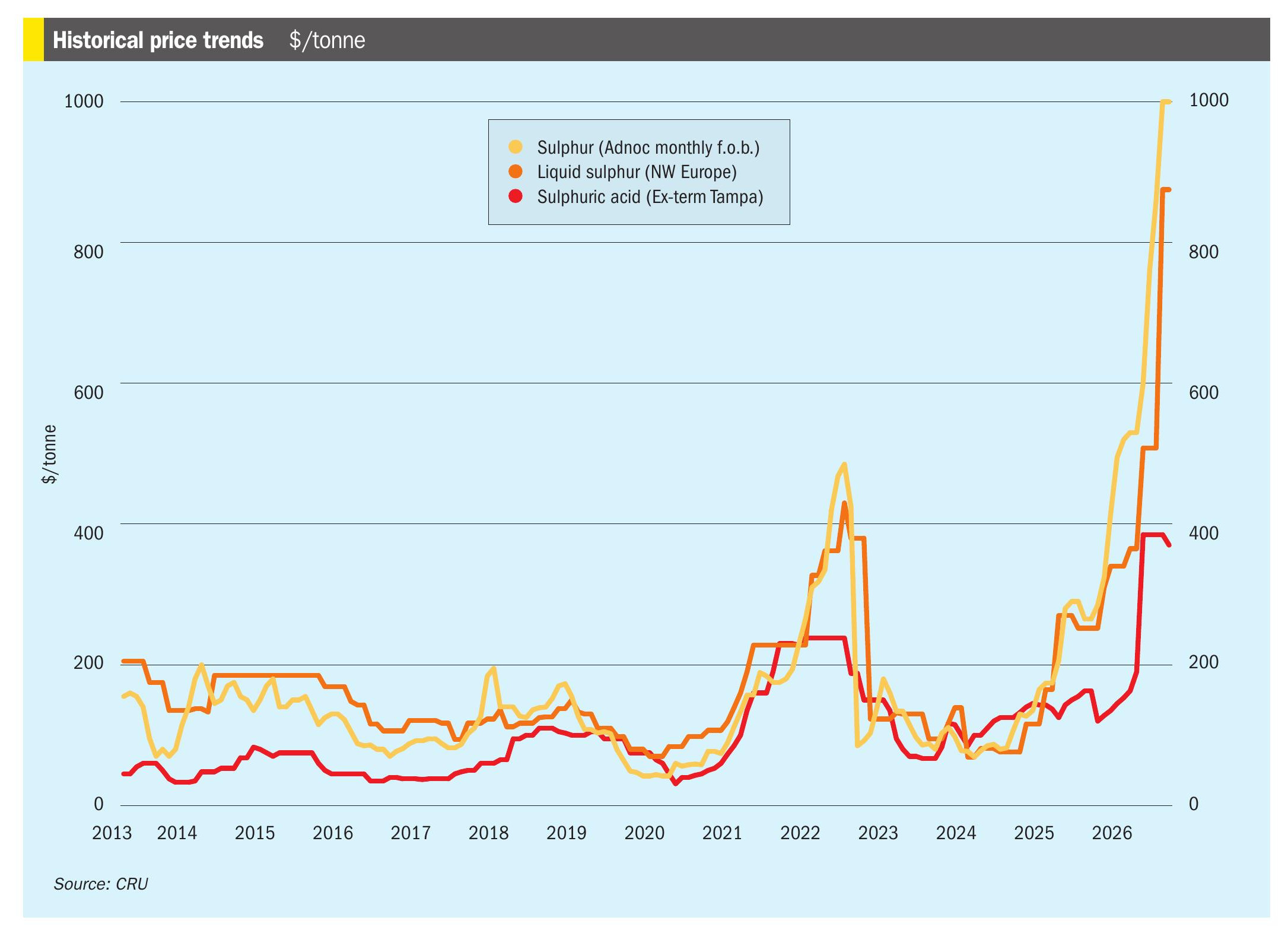
Historical price trends $/tonne

AMMONIA

  • Ammonia markets continue to be dominated by unplanned outages in Saudi Arabia (where the SAFCO 4 and one of the Ma’aden ammonia plants are both down, removing 2.3 million t/a of merchant ammonia from the market). This comes on top of other shutdowns earlier in the year on Trinidad, in the US and Australia.
  • In spite of restarts at PAU in Indonesia and EBIC in Egypt, there is a shortage of ammonia availability in the short term, and this tight availability is driving higher prices in all major markets. Early June saw Black Sea prices surge $90/t to netbacks above $520/t f.o.b., and Middle East rates higher than $600/t f.o.b. Some delivered prices to India and China were reported at $670/t c.fr.
  • Ammonia prices are now more than double their value at this time last year, and this pricing level is likely to drive demand destruction if it continues for any length of time.

UREA

  • Urea markets have also surged. India is back in the market, having not sourced as much urea as it had hoped in the first few months of the year. A large MMTC tender was due to close on June 24th.
  • Chinese authorities have become concerned over rising urea prices, which reached over $420/t in early June, with the National Development and Reform Commission (NDRC), China’s state planning agency, launching an investigation into the urea market, and saying that it will “strengthen market supervision and resolutely crack down on hoarding, price hikes and fabricating and disseminating information on price increases”. There was market speculation about a possible export ban.
  • Rising coal prices have helped sustain Chinese prices, and while falling grain prices have been a contra-indication, continued strong Indian buying looked likely to support urea prices for the time being.

METHANOL

  • Methanol prices have been stable after a ramp up of prices earlier in the year. Methanex reference prices for June were a rollover of May, at $430/t in the Asia-Pacific region.
  • Russian deliveries of methanol to Europe were impacted by the Euro2020 soccer championship, with deliveries via St Petersburg halted for six weeks in June and July.
  • In China, coal prices have risen by 60% from March to June, leading some methanol plants to scale back operations. At the same time, falling prices for oil and olefins lead to a squeeze on margins for Chinese MTO producers – representing half of Chinese methanol demand – with some producers idling plants. But rising energy prices may see a methanol price recovery in the second half of 2021.
  • Longer term, the US infrastructure bill has lifted methanol stocks with the expectation that new construction will draw in plastics, resins and fibreboard.

Latest in Outlook & Reviews

CRU Phosphates+Potash conference focuses on sulphur

CRU’s Phosphates+Potash Expoconference was held in Paris in mid-April, with the Iran crisis uppermost in everyone’s mind. Margins are under pressure, sulphur has become a strategic constraint, and the phosphates investment pipeline is thin. CRU Principal Consultant Humphrey Knight examined the fallout from the closure of the Strait of Hormuz, noting that fertilizers have been hit harder than most bulk commodities. A large share of exportable sulphur and traded urea normally originates in, or passes through, Gulf producers. The effective closure of the strait has squeezed the traded part of these markets, where international prices are set, and pushed benchmarks up sharply. The global phosphate market is structurally tight, and the combination of Chinese export policy and Middle East logistics has pushed the traded segment into a much more fragile state.

Supply crisis worsens

It is two months on from our previous issue, and almost none of the news has been good from sulphur and downstream markets. Only three sulphur cargoes are confirmed to have transited the Strait of Hormuz since the US and Israeli strikes on Iran began, all loaded at Ruwais, with destinations in India, Tanzania and Morocco, carrying a total of 160,000 tonnes. It is believed that a couple of Iranian vessels with a total of 75,000 tonnes may also have left covertly. But in spite of some Middle Eastern sulphur making its way to Saudi Red Sea ports or Duqm on Oman’s Indian Ocean coast, around 700,000 tonnes is still trapped on ships stranded in the Gulf, and coupled with production cuts in the region, it is estimated that over 1.2 million tonnes has so far been removed from the market.