
Nitrogen + Syngas 2023
CRU Events will host the 2023 Nitrogen + Syngas conference and exhibition at the Hyatt Regency Barcelona Tower in Barcelona, 6-8 March.


CRU Events will host the 2023 Nitrogen + Syngas conference and exhibition at the Hyatt Regency Barcelona Tower in Barcelona, 6-8 March.

Topsoe has agreed to supply an initial 500 MW of industrial-scale, solid oxide electrolyser cells (SOEC) to First Ammonia, a US company aiming to produce green ammonia for transportation fuel, power storage and generation, as well as fertilizer, at sites in northern Germany and the southwestern United States. The companies envisage that over the lifetime of the agreement some 5 GW of SOEC electrolysers will be supplied, potentially replacing almost 5 bcm of natural gas and eliminating the emission of 13 million t/a of CO 2 emissions. The facility to manufacture the electrolyser cells will be built in Herning, Denmark, and has recently received a final investment decisions from Topsoe’s board.

Maire Tecnimont subsidiary MyRechemical has been awarded a basic engineering contract for a waste to methanol and hydrogen plant to be located in Empoli, Tuscany. The scope of work includes the basic engineering design of the plant and the provision of necessary documentation to start the plant’s public authorisation process with the Tuscany region. The basic engineering phase is expected to be completed by the end of 2022. Once completed, the plant will process 256,000 t/a of non-recyclable waste and will produce 125,000 t/a of methanol and 1,400 t/a of hydrogen. The plant will use MyRechemical’s chemical conversion technology which allows the recovery of waste that cannot be mechanically recycled, or other types of unsortable dry waste. The carbon and hydrogen in the waste are converted via gasification into synthesis gas, which is used to produce low-carbon methanol and hydrogen.

Gidara Energy has agreed with the Port of Rotterdam to develop a new waste to methanol facility in the Netherlands: Advanced Methanol Rotterdam (AMR). Gidara will duplicate its Advanced Methanol Amsterdam project as a template for AMR, using Gidara’s patented high temperature Winkler (HTW® ) technology, which converts nonrecyclable waste to renewable fuels. This technology has been used commercially in four other waste to syngas production facilities. AMR will convert around 180,000 t/a of non-recyclable waste into 90,000 t/a of methanol, while capturing all waste streams for use; CO2 will be captured and led to local greenhouses; bottom product residue will be used for cement production; and other streams like ammonia and salts will be sold and put to use as feed stock for other industries and road salt respectively, creating a fully circular concept. The facility is scheduled to start detail engineering and construction in the first half of 2023, when a permit is received, and start production of renewable methanol in 2025.

New innovations, services and latest technologies to improve the operation and reliability of steam methane reformers from AMETEK Land, Kontrolltechnik, BD Energy Systems, Koch Engineered Solutions, and Quest integrity.

Switzerland-based EuroChem Group AG says it has entered into exclusive negotiations to acquire the nitrogen business of the Borealis group, after having submitted a binding offer. One of Europe’s leading fertilizer producers, Borealis operates fertilizer plants in Germany, Austria and France, as well as more than 50 distribution points across Europe. It supplies 3.9 million tonnes of fertilizer products per year, including 800,000 t/a of technical nitrogen solutions and 150,000 t/a of melamine via the Borealis LAT distribution network. It is a market leader in melamine, with its operations in Austria and Germany supplying primarily the woodworking industry. EuroChem says that melamine and technical nitrogen solutions represent important new business lines for the company to expand its nitrogen-based product portfolio in Europe.

Topsoe has begun operations at a demonstration plant for the production of methanol from biogas. The aim is to validate the company’s electrified technology for cost-competitive production of sustainable methanol from biogas as well as other products. The project is supported by the EUDP Energy Technology Development and Demonstration Program and is developed together with Aarhus University, Sintex A/S, Blue World Technology, Technical University of Denmark, Energinet A/S, Aalborg University, and Plan-Energi. The demonstration plant is located at Aarhus University’s research facility in Foulum, and will have an annual capacity of 7.9 t/a of CO 2 -neutral methanol from biogas and green power and is scheduled to be fully operational by the beginning of 2022. It uses Topsoe’s eSMR ™ technology, which is CO 2 -neutral when based on biogas as feedstock and green electricity for heating. It also uses half the CO 2 that makes up about 40% of biogas and typically is costly to separate and vent in production of grid quality biogas.

MegaZonE™ is a newly introduced layered loading technology for boiling water-cooled reactors used for methanol synthesis. This new concept is one of the latest results of the long-standing collaboration between Air Liquide Engineering & Construction and Clariant Catalysts to improve the methanol process flowsheet and optimise catalyst performance in the complete reactor system.

A consortium has unveiled plans to build one of the largest green hydrogen plants in the world in a bid to make Oman a leader in renewable energy technology. The $30 billion project is being developed by Oman’s state-owned oil firm OQ, green fuels developer InterContinental Energy and Kuwait government-backed renewables investor EnerTech. Construction is scheduled to start in 2028 in Al Wusta governorate on the Arabian Sea. It will be built in stages, with the aim to be at full capacity by 2038, powered by 25 GW of wind and solar energy. Two years has already been spent on solar and wind monitoring analysis for the development. According to the consortium, the site chosen has the optimal diurnal profile of strong wind at night and reliable sun during the day, and is also located near the coast for seawater intake and electrolysis.
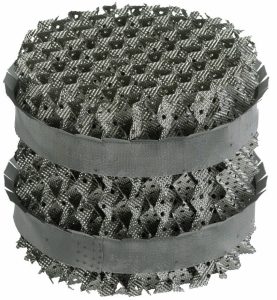
By using a Rectisol™ demonstration unit at one of Air Liquide’s industrial production sites, Air Liquide Engineering & Construction has gained unique know-how in Rectisol™ column design with structured packings. S. Schmidt, R. Szabo, M. Linicus and S. Corbet report on how the application of commercially available structured packings in the absorber columns of a Rectisol™ unit results in significant capex and opex savings.