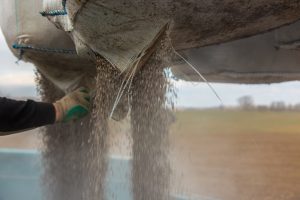
Reducing dust, enhancing safety: a coating-based approach
Arkema's John Suldickas, Heather McKay and Juan Gonzalez Leon explore innovations in fertilizer dust control.


Arkema's John Suldickas, Heather McKay and Juan Gonzalez Leon explore innovations in fertilizer dust control.

Alexandra Dorison of the International Fertilizer Association (IFA) highlights the successes and rapid progress to date of the Sustainable Fertilizer Academy (SFA).

In this CRU Insight, Anthony Rizzo explains why market participants should expect an uneven global demand picture in 2026 and highlights regional variations.

Selected highlights of the International Fertilizer Association’s Annual Conference in Monaco in mid-May.

President Donald Trump delayed his ‘liberation day” tariffs by three months on 9th April, while simultaneously ramping up levies on China.

President Donald Trump delayed his ‘liberation day” tariffs by three months on 9th April, while simultaneously ramping up levies on China. In this latest twist to the on-off US tariffs saga, the Trump administration’s 90-day pause on additional duties should provide international suppliers to the world’s biggest fertilizer market with some respite – for now. With the exception of China, the US will now cut back its so-called ‘reciprocal tariffs’ to 10% for the duration of a three-month suspension period. The European Union’s tariff is now halved to 10%, for example, with the trade bloc also pausing its trade countermeasures against the US.

Daewoo Engineering & Construction has signed a $700 million framework agreement to build a fertilizer plant in Turkmenistan. The agreement was signed in Seoul with Turkmenistan's state-owned chemical firm, Turkmenhimiya, according to the Turkmen Ministry of Trade, Industry and Energy, noting the Korean firm was named the preferred bidder for the project in October. The project aims to construct a fertilizer plant that will extract phosphoric acid from phosphate rocks and process the substance into 300,000 t/a of annually in eastern Turkmenistan by 2029.
The Tunisian cabinet has met to review its future programme for phosphate production, transport, and processing for the 2025-2030 period, as well as the current situation of the Tunisian Chemical Group and its work plan for the same period, according to a government statement. The prime minister stressed the need to develop phosphate production as a national resource and a cornerstone of the national economy that must regain its role and position in supporting state revenues and wealth creation, including increasing production capacity, processing, and exports, while investing in modern technology to enhance productivity, exploring new export markets, and prioritising environmental considerations.

Dr M.P. Sukumaran Nair, Director of the Centre for Green Technology & Management, Cochin, India and former Secretary to the Chief Minister of Kerala discusses the challenges facing India’s agriculture and fertilizer industry.

In this CRU Insight, Halima Abu Ali and Charlie Stephen look at what changes to the EU’s carbon taxation regime will mean for the fertilizer industry.