Fertilizer Industry News Roundup
Paradeep Phosphates Limited (PPL) and Mangalore Chemicals & Fertilizers Limited (MCFL) have agreed to merge.
Indian fertilizer producers Mangalore Chemicals & Fertilizers (MCFL) and Paradeep Phosphates (PPL) have announced that the companies intend to merge, allowing them to consolidate their operations, according to a company statement. The new merged company, to be called PPL, will have a total production capacity of 3.6 million t/a of fertilizers.
NextChem Tech, has signed a contract with Paul Wurth SA, a subsidiary of SMS group, and Norsk e-Fuel AS for a licensing and engineering design package relating to its NX CPO (catalytic partial oxidation) technology, which will be used in an industrial scale plant producing sustainable aviation fuel (SAF) from green hydrogen and biogenic CO2 in Mosjøen, Norway. NextChem’s NX CPO technology produces synthesis gas via a very fast controlled partial oxidation reaction. When applied to synthetic fuel production, it can improve carbon efficiency recovery yield. The first plant developed by Norsk e-Fuel will have a production capacity of 40,000 t/a of green fuel and will enter operation after 2026. Based on the initial design, two additional facilities with a capacity of around 80 000 t/a each are planned to be built by 2030. The fuels will current aviation emissions.
OCI Global says that it has reached an agreement for the sale of 100% of its interest in its large-scale nitrogen fertilizer subsidiary the Iowa Fertilizer Company LLC, located in Wever, Iowa, to Koch Ag & Energy Solutions for $3.6 billion. Completion of the transaction remains subject to US anti-trust approval and other customary closing conditions. The transaction is expected to close in 2024. Morgan Stanley & Co. International plc is serving as financial advisor to OCI on the transaction. IFCO produced 1.2 million t/a of urea ammonium nitrate (UAN) in 2021 and 700,000 t/a of anhydrous ammonia, as well as 700,000 t/a of diesel exhaust fluid (DEF).
Maire Group subsidiary MyRechemical has been awarded a feasibility study for the integration of its proprietary waste-tosyngas technology in a large-scale conversion plant that would transform solid municipal waste into 120,000 t/a of sustainable aviation fuel (SAF). MyRechemical would provide the gasification unit to transform solid waste streams into synthesis gas, which would then be converted into low carbon ethanol and then to SAF.
Granulation technology generates a premium urea end-product in large volumes capable of withstanding lengthy storage and extreme shipping conditions. Prilling technology, meanwhile, given its typically lower investment cost, can be an attractive option for smaller-scale urea producers supplying local markets. Stamicarbon’s Dr Wilfried Dirkx, Ahmed Shams and Branislav Manic explore the technology options for urea finishing.
New regulatory developments in Europe are focusing attention on eliminating microplastic residues in soils by adopting biodegradable fertilizer coatings. Major technology licensors and engineering companies are also developing new coating technologies for controlled-release fertilizers (CRFs).
Proman has signed a memorandum of understanding (MoU) with Mitsubishi Corp to collaborate on the development of a blue ammonia plant at Lake Charles, Louisiana. This new facility will aim to produce around 1.2 million t/a of low carbon ammonia, making it one of the largest of its kind in the world. The plant will incorporate carbon capture and sequestration technology. Proman says that this development aligns with the company’s commitment to sustainability and reducing greenhouse gas emissions. The proposed ammonia plant will be located at Proman’s existing site in Lake Charles, adjacent to its gas-to-methanol plant, which is also currently being developed.
Tecnimont, part of MAIRE’s Integrated E&C Solutions business unit, has signed a letter of award with ADNOC for the onshore processing plant of the Hail and Ghasha Development Project. The award was signed at ADIPEC, the world’s largest energy summit. The project aims to operate with net zero CO 2 emissions, in part due to the facility’s CO 2 carbon capture and recovery units, which will allow the capture and storage of CO 2 . The project will capture 1.5 million t/a of CO 2 , taking ADNOC’s committed carbon capture capacity to almost 4 million t/a. The company recently announced its decision to double its carbon capture capacity to 10 million t/a by 2030. The Hail and Ghasha CO 2 will be captured, transported onshore and stored underground, while low-carbon hydrogen will be produced to replace fuel gas and further reduce emissions, according to ADNOC. The project will also use power from nuclear power plants and renewable sources from the grid.
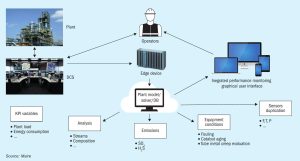
With the growing global demand for food and the rise in ecological challenges, there’s a pressing need for a more sustainable and environmentally-friendly approach to fertilizer production. Achieving a sustainable increase in plant load and operational margins through improved operations is a demanding task. Luc Dieltjens and Ali El Sibai of Stamicarbon discuss how a plant can effectively address these challenges with digital tools to optimise the process.