Tag: Prices

Price Trends

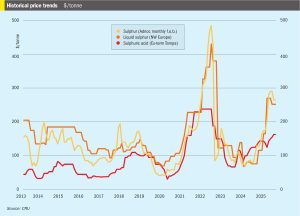
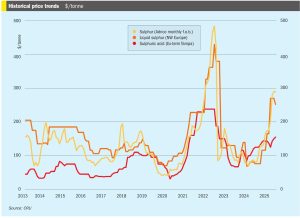
Global sulphur benchmarks rallied at the end of February, underpinned by strong demand in Indonesia and stock drawdowns in China as fresh European sanctions on Russia targeted the port of Ust-Luga. Chinese buyers paid up to $225t/t c.fr for a cargo, with unconfirmed rumours of business at even higher levels. However, delivered prices still lag domestic port spot prices in China, which are now assessed at a delivered-price equivalent of around $242/t c.fr. China’s delivered sulphur price jumped significantly as port inventories declined, and new arrivals were limited. Only two new cargoes were reported in the last week of February, one from a mainstream source into southern China at $205/t c.fr, and the second at $225/t c.fr by a phosphate producer for the Yangtze River. The sulphur port spot transaction price is reported at around 2,0402,050 yuan/t FCA ($281-283/t), with the low-end up $26/t and high-end up $25/t compared with previous settlements. That port price indicates delivered values at around $242/t c.fr, which is $17/t higher than the import price on the Yangtze. Phosphate producers need to purchase more sulphur to meet the increased buying activity in northeastern market and the improving spring application season demand in northern China. Still, market sales availability is limited, as most port tonnes are held by traders instead of end-users, while traders are selling limited quantities now to push prices higher. Chinese total port inventory dropped to 1.89 million tonnes by 26 February 2025. The quantity at Yangtze river ports declined 59,000 tonnes to 633,000 tonnes, while Dafeng port inventory decreased 20,000 tonnes to 450,000 tonnes.

Sulphur prices soaring

The past few weeks have seen sulphur prices spiking after a steady rise since 3Q 2024. At time of writing, delivered prices to a variety of locations were around $280/t c.fr, their highest level since mid-2022 when the price of commodities of all kinds jumped in the wake of the Russian invasion of Ukraine and subsequent sanctions. Steady buying from Indonesia and China, the two largest importers of sulphur, appears to have supported the market, in China’s case mainly for phosphate production as well as a variety of industrial processes, and in Indonesia’s case to feed the high pressure acid leach (HPAL) plants that are producing nickel for the battery and stainless steel industries. Although Chinese buying has dropped off slightly since Lunar New Year, and demand has also slackened in India, Indonesia’s appetite continues unabated, having tripled its nickel production since the start of the decade to become the world’s largest producer, representing 60% of global supply in 2024.

Tariff uncertainties cloud the picture

Nitrogen+Syngas went to press just a few days before Donald Trump’s swearing-in as the next president of the United States. While it is sometimes difficult to sort the truth from the hyperbole in his public pronouncements, nevertheless, if taken at face value, they would seem to indicate that we may be in for a turbulent four years in commodity markets in particular. While he is an avowed military non-interventionist, on the economic policy side he has emerged as a firm believer in the power of tariffs to alter markets in the favour of the US, and has promised 20% tariffs on all goods entering the US, potentially rising to 25% for Canada and Mexico, and 60% for his particular bugbear, China, sparking a scramble for wholesalers to stock up in the last few weeks of the Biden presidency. Trump previously raised tariffs on Chinese goods entering the US to 20% during his first term, and the Biden administration made no attempt to reverse this, and even added some additional ones, for example 20% on Russian and Moroccan phosphate imports.

Price Trends

Global sulphur prices were mostly assessed flat in mid-January, with only slight changes for China, Indonesia and India, while the first quarter contracts for the Middle East, North Africa and Tampa increased from the previous quarter. Overall, the number of transactions taking place globally has declined as subdued demand has limited trading activity in most delivered markets. The current sulphur price environment has been shaped by the combination of rising Chinese demand and higher Middle East f.o.b. prices in the second half of last year. As a result, some consumer markets such as Indonesia and India have been subject to upward pressure in order to remain attractive destinations. But demand remained lacklustre across delivered markets, leaving prices relatively stable.