
Ammonia safety update
As well as a recent US Chemical Safety Board report on an ammonia release incident, the past year has seen considerable focus on safety of ammonia at sea, in preparation for its possible use as a clean burning maritime fuel.


As well as a recent US Chemical Safety Board report on an ammonia release incident, the past year has seen considerable focus on safety of ammonia at sea, in preparation for its possible use as a clean burning maritime fuel.

The US Chemical Safety and Hazard Investigation Board (CSB) has released a second update on its ongoing investigation into the fatal hydrogen sulphide release that occurred on October 10, 2024, at the PEMEX Deer Park Refinery in Deer Park, Texas. Two contract workers died during the incident, and over 13 tonnes of hydrogen sulphide gas were released. Local authorities issued shelter-in-place orders lasting several hours for the neighbouring cities of Deer Park and Pasadena.
Two dam failures at the Morowali industrial park in Indonesia have killed three people. On March 16, during heavy rains, the PT Huayue Nickel Cobalt tailings storage facility at the Morowali industrial park failed, and tailings flowed into the Bahadopi River. The breach flooded facilities at the industrial park and the village of Labota. Five days later another tailings dam inside the industrial park, owned by PT Qing Mei Bang (QMB) New Energy Materials, collapsed, killing three workers. The affected tailings facilities store acidic waste from high pressure acid leaching (HPAL). It is estimated that for every ton of nickel, HPAL processing generates 150-200 tons of tailings. The affected facilities use filtered tailings, where some of the water is removed from the tailings before they are placed the dam. However, heavy rains, landslips and seismic activity appear to have affected the stability of some of the dams.
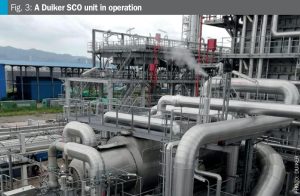
Common risks of ammonia cracking as a new technology and how these risks can be recognised and mitigated by applying an innovative approach of the technology maturation process is described as seen through the eyes of an end user/investor. Addressing those risks is pivotal to enable end users to choose the best technology for their needs. Albert Lanser of Duiker Clean Technologies discusses some of these risks and how they have been addressed in its novel technology for producing the lowest levelised cost of hydrogen via its unique ammonia cracking process.
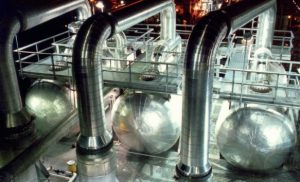
Wood presents the pros and cons of leaving a refinery SRU on hot standby versus long-term idle taking into consideration reliability, safety, and operations responsibilities during extended downtime.

Risk analysis tools such as hazard identification (HAZID), is often a first step in broader risk management and is especially valuable for green ammonia, where new technologies and processes introduce novel risks. This article explores various aspects of HAZID, from the basics of hazard identification to unique considerations specific to green ammonia facilities.

Esben Sørensen and Glenn Rexwinkel of Plug Power review the safety aspects of integrating hydrogen production by electrolysis into existing ammonia processes. Novel safety risks associated with such changes are surmountable and the analysis presented shows that green ammonia production can be no more hazardous than traditional ammonia production.

Carbon Recycling International (CRI), which operates a geothermally powered green methanol plant at Svartsengi, 40km southwest of Reykjavik, had to evacuate its site in late November when a 3km fissure opened in the earth a few kilometres away and lava began spilling across adjacent land. Satellite photos of the area taken on November 24 show a large field of molten and cooled lava to the north, west, and south of Svartsengi, though the plant itself remained undamaged. CRI’s Iceland facility runs on CO2 , water, and renewable electricity from the Svartsengi geothermal power station. CRI says the low-carbon energy source allows it to produce 4,000 t/a of methanol with a greenhouse gas footprint just 10–20% that of conventional methanol.
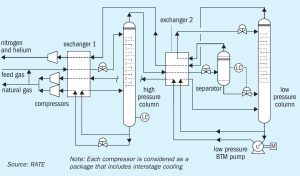
As the oil and gas industry focus on new requirements for CO2 recovery, cryogenic processes come under the spotlight. Mahin Rameshni and Stephen Santo of RATE USA discuss the importance of cryogenic processes in acid gas sweetening. Liquefied H2 S and CO2 reinjection is proposed as a cost effective alternative to large sulphur plants.
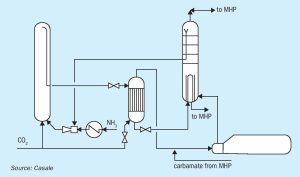
We highlight recent production advances and innovations in nitrogen fertilizer production from Casale and Stamicarbon, two global leaders in process technology.