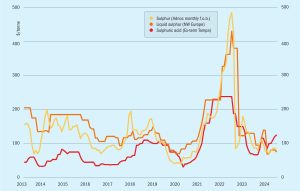
Market Outlook
Sulphur prices are expected to recover from declines in May and June and continue climbing over the coming months, though good availability will limit upside.


Sulphur prices are expected to recover from declines in May and June and continue climbing over the coming months, though good availability will limit upside.
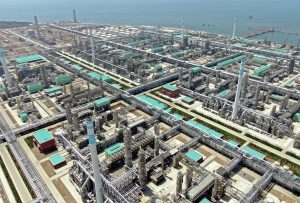
The refining industry continues to pivot towards Asia, with knock-on effects for sulphur output.

Liquid sulphur presents unique challenges in its handling and transport compared to solid sulphur.

Sulphur prices in China are expected to recover with downstream demand anticipated to surge in the second half of the year and good affordability to support raw materials purchasing. Chinese nitrogen, phosphate, and potash prices have surged, driven by heightened demand for the summer corn application season. In particular, average 11-44 MAP prices jumped 16% from $390/t ex-works to $463/t in Hubei province. However, sulphur prices have taken a while to follow the trend on phosphate prices. Port prices have fluctuated in the range of $126-130/t c.fr since late March, and import prices fell from a high of $112/t c.fr to $100/t c.fr, capped by high port inventory and sufficient supply. Port inventories in China remain around 2.8 million tonnes, well above the 2022 average of 1.4 million tonnes and the 2023 average of 2.07 million tonnes. These elevated stock levels limited the upside for prices in China and provided buyers with options. At the start of July, Sinopec’s Puguang, the largest sulphur producer in China, increased its sulphur sales prices at Wanzhou port up $4/t RMB980/t, while its factory price at Dazhou was up RMB20/t at RMB950/t ex-works. These prices are considerably down from RMB1,600/t in December 2022 and RMB 2,945/t from mid-June 2022 and are the lowest since July 2023, but are still up from a low of RMB605-655/t at the end of August 2020.
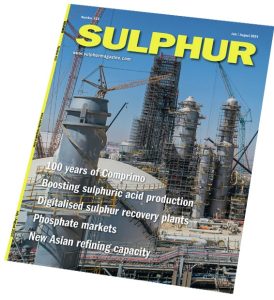
While the events of the past few years have been difficult for Europe on many fronts, including a wholesale realignment of its energy sources with the restriction of access to Russian oil and gas, the effect on Europe’s sulphur production seems likely to be just as profound.
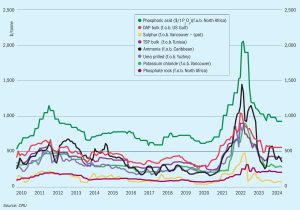
Market as of 20th June 2024. Urea: Prices remain stable while the market awaits clear price direction on whether to hold current f.o.b. levels or to push higher.
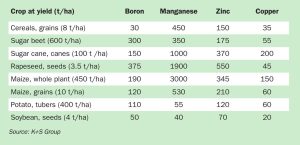
Dr Setareh Jamali Jaghdani and professor Jóska Gerendás of K+S Group outline how micronutrient management, by positively influencing plant physiology and development, helps maximise crop yields.

Urea: Prices continued their global decline in mid-April, including at New Orleans. The notable exception was Brazil where prices firmed due to buyer interest in the market for May and beyond.

Sulphur plays an important role in crop nutrition. Indeed, sulphur is increasingly being recognised as the fourth major crop nutrient alongside N, P and K. However, a combination of intensive agricultural practices, increasing application of high-analysis fertilizers and tighter air quality regulations has led to increasing sulphur deficiency in soils. In this insight article, CRU’s Peter Harrisson looks at what’s driving sulphur deficiency and whether there’s a gap in the market for sulphur fertilizers.

Sulphur is a necessary nutrient for strong and healthy plant-growth and disease resistance. Fertipaq manufactures the liquid suspension fertilizer S-600 using sulphur recovered wastewater and biogas streams. This organic product is an ideal nutrient source for crops with a high sulphur requirement.