India’s hunger for urea
India’s push to replace its sizeable urea imports with home grown capacity continues, but may not keep pace with rising domestic demand.
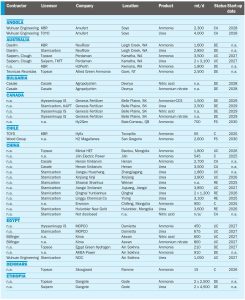
Nitrogen+Syngas ’s annual listing of new ammonia, urea, nitric acid and ammonium nitrate plants.
thyssenkrupp Uhde says that it has been selected by MOPCO – the Misr Fertilizers Production Company – to supply advanced technology for three existing ammonia and urea plants in Damietta, Egypt, to improve the sustainability of production. Using an innovative carbon capture and usage (CCU) solution, the aim is to remove up to 145,000 t/a of CO2 from the flue gas of the existing ammonia production and use them to boost urea production. At the same time, three 150 t/d axial-radial flow uhde® ammonia converter cartridges using JM’s high performance KATALCOTM 74-1catalyst will be installed in the existing converters to increase ammonia production capacity while lowering natural gas consumption in the synthesis loop by around 10%. To bring down CO2 emissions further, additional green hydrogen feedstock will be sourced from new water electrolysis units powered by renewable energy. MOPCO plans to produce up to 150,000 t/a of green ammonia.
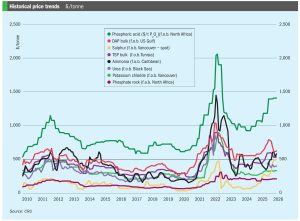
Support for ammonia prices in markets east of Suez eroded during February. The ongoing bubble of support seen in NW Europe remained just about intact, though news of further declines at Tampa for March and slumping natural-gas prices should begin to eat away at any remaining support in the West. After declining $70/t during the first two months of 2025, the Tampa settlement between Yara and Mosaic was revised down a further $40/t for March, imposing further downward pressure on f.o.b. values in Trinidad and the US Gulf.
In her Indian 2025-26 budget presentation on February 1st, finance minster Nirmala Sitharaman announced a $1.15 billion investment to build a new 1.27 million t/a ammonia-urea complex at Namrup in Assam province. The plant will be a brownfield development at the Brahmaputra Valley Fertiliser Corporation Ltd (BVFCL) site. Sitharaman said that it was part of the Indian government’s commitment to strengthening agricultural infrastructure and self-sufficiency in fertilizer production. The gas-based ammonia-urea plant is expected to start up in 2028-29 and will supply farmers in northeast and eastern India.
Toyo Engineering Corporation (TEC) will license its ACES-21 urea technology to Angolan fertilizer producer Amufert for the Soyo urea plant in Angola. The plant will have a capacity of 4,000 t/d and will be the first of its kind in the country, based on abundant local natural gas supplies. Toyo Engineering will supply licensing, basic design, certain equipment procurement and technical services, while international engineering company Wuhuan Engineering will lead the engineering, procurement and construction of the plant. Production is expected to start in 2027. KBR was previously awarded the license for the 2,300 t/d ammonia plant in November 2024 (see Nitrogen+Syngas 393, Jan/Feb 2025, p6).
• Prices look set to come under further pressure moving into March, particularly east of Suez. Prices in the West – specifically in northwest Europe – have enjoyed a partial degree of support through February, though this appears unlikely to hold for much longer.
NextChem subsidiary Stamicarbon has been selected to provide the process design package to upgrade the Hulunbuir New Gold Chemical Co., Ltd.’s urea plant in Hulunbuir, Inner Mongolia, using its proprietary NX STAMI UreaTM technology. The upgrade will integrate Stamicarbon’s EVOLVE MELT MP flash design to enhance operational efficiency and reliability while minimizing process steam consumption. Following the upgrade, the plant’s capacity will be increased by about 26% to 3,600 t/d, with an expected high-pressure steam reduction of 15%.
Maire Group says that its nitrogen fertilizer technology licensor Stamicarbon has been awarded new contracts related to its NX STAMI UreaTM technology in Canada. The first award is a process design package and the licensing of an integrated urea and diesel exhaust fluid (DEF) production plant currently being developed by Genesis Fertilizers, a farmer-owned consortium, at Belle Plaine, Saskatchewan. The plant will have a urea melt capacity of 2,500 t/d, with operations expected to begin by 2029. Also thanks to a carbon capture and sequestration unit, it will be the first proposed low-carbon nitrogen fertilizer plant in Canada. Stamicarbon will apply its proprietary flash urea melt technology to enhance operational efficiency and reliability while minimising process steam consumption. The plant will also include a DEF facility with a production capacity of 1,500 t/d.
Sulphur’s key role as a plant nutrient means that its use as a fertilizer continues to be a major area of demand.