• Skip to main content

    Nitrogen+Syngas 383 May-Jun 2023

    Price Trends


    Price Trends

    Market Insight courtesy of Argus Media

    NITROGEN

    Ammonia prices dropped again towards the end of April across several regions, backed up by a $55/t drop in the latest monthly Tampa contract price, as the market continues to work towards its floor. Yara agreed the Tampa price with Mosaic at $380/t c.fr for May, representing a Caribbean netback of around $330-335/t f.o.b. But firmer demand from northwest Europe appears to be pointing towards some potential stability.

    A series of outages and plant maintenance in the Americas and north Africa is moving the market more into balance for May and June. In the east, the focus remains on China, where negotiations are now heading below $300/t c.fr and increasing competition between Middle East and southeast Asian sellers to reduce stockpiles.

    Recent market drivers include NW European demand; fresh sales are emerging in Europe. Discussions were below $400/t c.fr at the end of April, but a sale into France was reported above $400/t cfr. The details were not confirmed by the buyer. There are also curtailments on Trinidad; at least one plant on Trinidad has been forced to come offline because of issues over gas supply.

    In Algeria, producer Sorfert has brought one plant offline today for maintenance, with the plant expected to come back online in mid-May. Algerian exports reached over 130,000 tonnes in April.

    In China, storage tanks at Zhanjiang are at full capacity, delaying cargoes and dampening recent buying interest. Around 70,000 tonnes are in the May line up, down from 120,000 tonnes in April.

    Scarcity continued to drive prompt urea prices higher in some markets at the end of April, though sentiment remains weak for June cargoes. The US market remains short on urea at the front end of the curve and prices spiked to reflect this. Nola barges traded up to $450/st f.o.b. ($490/t c.fr) for April, up by 55% from this year’s low-point. Southeast Asia remains short on urea amid planned and unplanned turnarounds and a cargo traded at around $345/t f.o.b., up by around $20/t on last business.

    In Europe, producers began the ‘new season’ campaign for summer AN/CAN shipments into western Europe with apparently strong uptake. This, in turn is driving interest in urea and ammonium sulphate – though little activity on UAN as much was traded earlier.

    Recent urea market drivers include the ongoing rally in the US, which continues to prompt short-covering and adjustment of shipping schedules but, when demand slows in May this will likely cool global markets and traders are already positioning around this. In China spot export trade in urea is picking up, albeit slowly, which should place a clear ceiling on urea prices.

    Table 1: Price indications

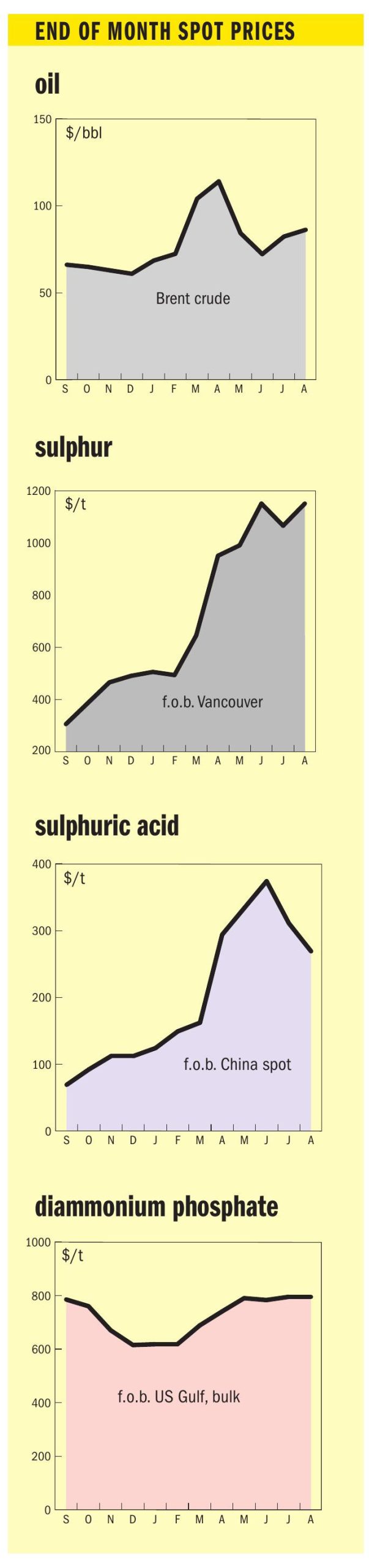
    END OF MONTH SPOT PRICES

    natural gas

    ammonia

    urea

    diammonium phosphate

    Latest in Outlook & Reviews

    Uncharted waters

    The fragile ceasefire between the United States and Iran broke down at the start of July, just three weeks after the signing of the June memorandum of understanding, after Iran fired at several vessels who had failed to notify them of their transit of the Strait of Hormuz, and the US retaliated with a missile barrage. While the two month negotiation period it had specified to solve all of the outstanding issues between the two parties had always seemed over-ambitious, market participants had at least expected to have that grace period to arrange for new cargoes and tranship them through the Strait. Now that the ceasefire has ended early, markets are truly entering uncharted waters.

    Price Trends

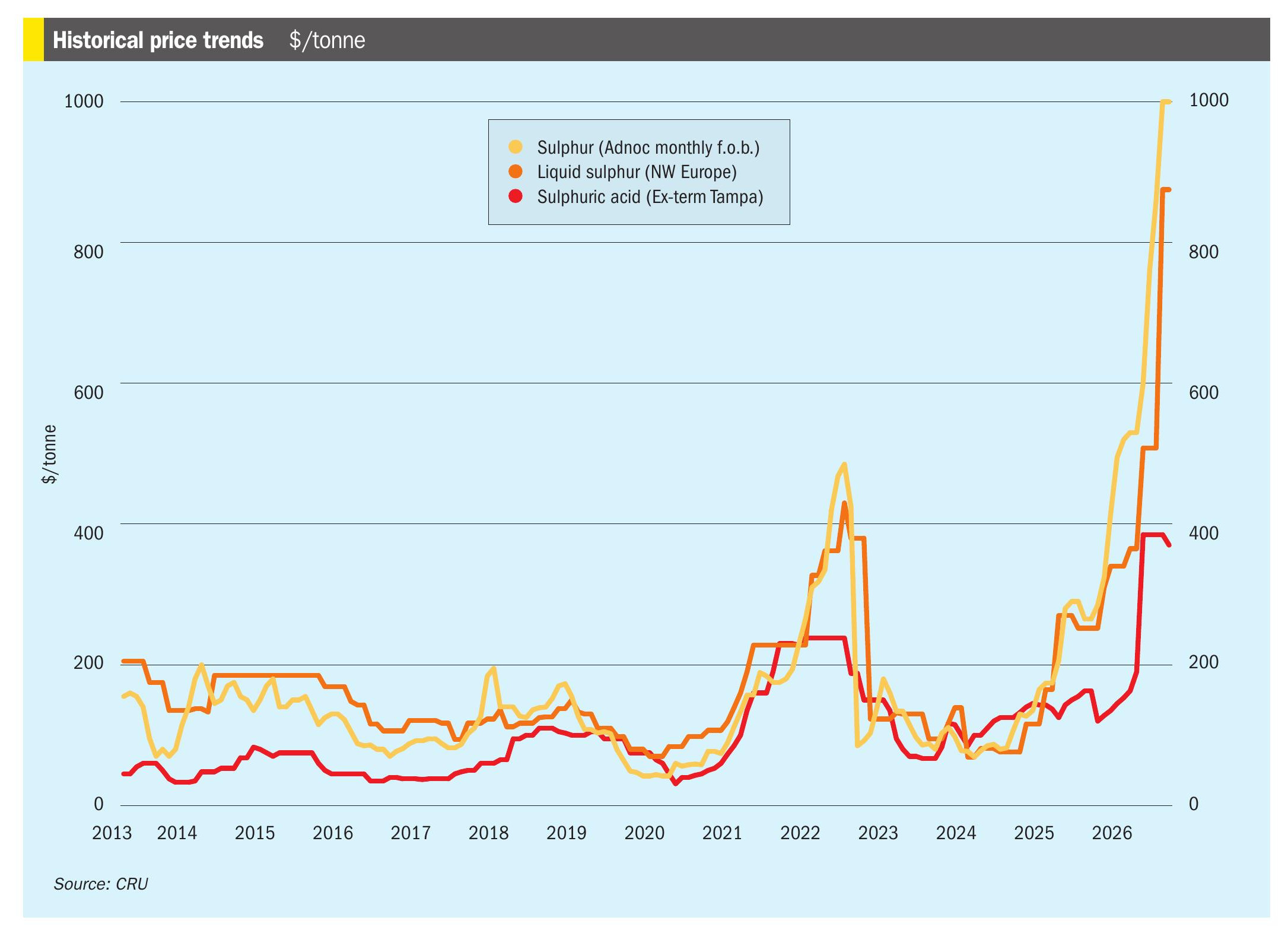
    The global sulphur market has entered a holding pattern, as a wave of bearish sentiment has so far failed to move stubbornly high spot prices. The departure of a significant volume of product from the Middle East has emboldened buyers and shifted market sentiment firmly towards bearish, but at time of writing this has so far failed to translate into lower prices. With sellers in no hurry to lower prices and spot availability still tight, the market has stalled as both sides wait for the other to blink first.